


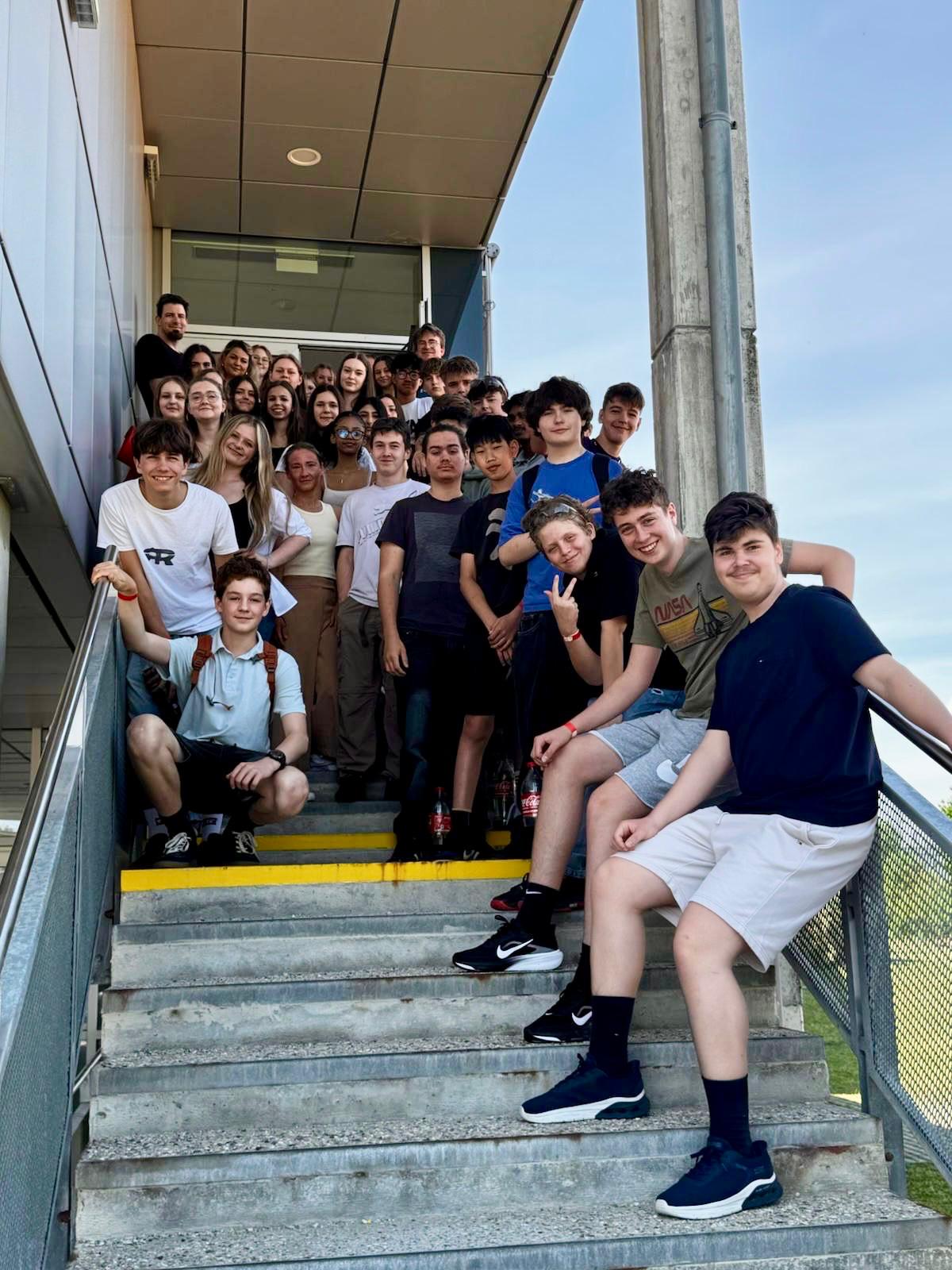
From 1 to 3 June 2026, students and teachers from Deutsche Schule Bratislava (DSB) gathered in Vienna for the final bootcamp of the ICE Robotics project. What began as an educational journey quickly became a memorable experience that combined technology, creativity, scientific discovery and cross-border cooperation.
Over three intensive days, 13 students and 2 teachers explored the three pillars of the ICE Robotics project: 3D printing, educational robotics and artificial intelligence.
Day 1: From Digital Design to the Streets of Vienna
The bootcamp opened with a hands-on introduction to 3D modelling and 3D printing. Students learned how digital ideas become physical objects and discovered the principles behind additive manufacturing. Working with professional equipment and software, they transformed their own concepts into printable designs while gaining insight into how engineers and designers use these technologies in real-world applications.
After the workshop, the group had an opportunity to experience Vienna from a different perspective during an afternoon visit to the famous Prater amusement park. The informal setting allowed students to get to know each other better and strengthen the team spirit that would be essential during the following activities.
Day 2: STEM Education in Practice and Dancing Robots
The second day began with a visit to BRG Simongasse, one of the Austrian partner schools participating in the project. The students were welcomed by the school management and introduced to the local educational environment.
One of the highlights of the visit was participation in STEM activities and experiments conducted in the school’s chemistry laboratory and outdoor learning spaces. The students observed how inquiry-based learning and practical experimentation are integrated into everyday teaching, providing inspiration for both students and teachers.
In the afternoon, the focus shifted to educational robotics. Working with mBot2 robots, the participants were divided into three international teams and challenged to create a coordinated dance performance.
The task required much more than simply writing code. Students had to collaborate, communicate, test ideas, solve unexpected problems and synchronise the movements of five robots into a single choreography. The room quickly filled with excitement as teams refined their programs and watched their robots perform increasingly complex routines.
By the end of the session, every team had successfully transformed lines of code into a creative robotic performance, demonstrating how technology can become a medium for teamwork and artistic expression.
Day 3: Exploring the Future with Artificial Intelligence
The final day focused on one of the most rapidly evolving technologies of our time: artificial intelligence.
The AI module was led by Patrick Tham from DaVinci Lab, who introduced students to practical applications of generative AI and machine learning. Through interactive activities and discussions, participants explored how AI tools can support creativity, education and everyday problem-solving, while also learning about the importance of critical thinking and responsible use of technology.
For many students, this was their first opportunity to engage directly with advanced AI tools in a structured educational setting. The workshop encouraged them not only to use technology but also to question, evaluate and understand it.
Celebrating Achievement and Looking Ahead
Following the AI workshop, the bootcamp concluded with a closing ceremony and certificate presentation. Students reflected on what they had learned, shared their experiences and celebrated three days of intensive collaboration.
The participants were also introduced to RoCoCo (Robotic Correspondence Competition), which offers an opportunity to continue developing their robotics skills beyond the bootcamp and remain connected to the growing ICE Robotics community.
As the final bootcamp of the project, the event represented much more than the completion of a programme. It demonstrated how cross-border cooperation can inspire young people to engage with technology, build international friendships and develop the skills needed for the future.
Over the course of the ICE Robotics project, dozens of students and teachers from Slovakia and Austria have discovered that robotics, artificial intelligence and digital fabrication are not only technical disciplines. They are powerful tools for creativity, collaboration and innovation.
The Vienna bootcamp was a fitting conclusion to that journey.