


Artificial intelligence is rapidly reshaping the educational landscape, prompting school leaders, teachers, and parents to ask a fundamental question: What is the true role of AI in the learning process?
One of the most talked-about experiments in the educational space is Alpha School, an “AI-first” private school network founded in Austin, Texas[1][2]. While Alpha School’s model offers intriguing insights into adaptive learning, it also raises critical concerns regarding pedagogy, screen time, and the removal of professional educators[3][4].
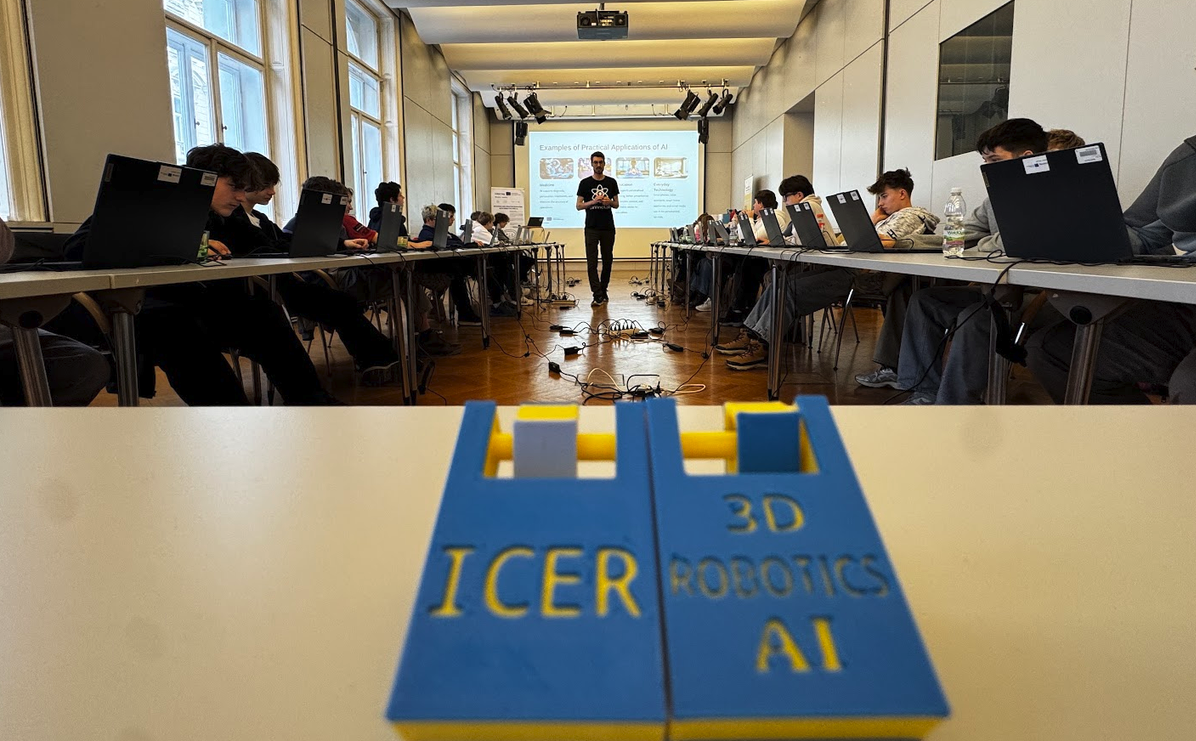
At ICER, we take a fundamentally different approach. While we strongly advocate for incorporating AI into schools, we place the teacher firmly at the center of the learning process as the vital interface between pupils and technology. Here is an overview of the Alpha School model, its pros and cons, and why ICER’s human-centered model offers a far more sustainable path forward for modern education.
Understanding Alpha School: The “2-Hour AI Learning” Concept
Alpha School operates on a bold proposition: compressing all traditional K–12 core academic subjects into just two hours per day using adaptive software, leaving the remaining four hours of the school day for hands-on, real-world “life skills” workshops[2].
Key features of the Alpha model include:
- Mastery-Based Progression: Rather than advancing students based on arbitrary age cohorts or calendar schedules, students move forward only after demonstrating complete mastery (typically scoring 90% or higher) on digital problem sets[1][7].
- Rebranding Teachers as “Guides”: Alpha replaces certified, subject-matter teachers with non-specialist “Guides” at roughly a 1:5 ratio[3]. Guides do not deliver lectures or explain complex concepts; instead, they monitor behavioral metrics, enforce discipline, and lead afternoon workshops[3][8].
- Life Skills Workshops: After the morning academic block, students engage in practical projects such as public speaking, robotics, chess, entrepreneurship, and building real-world businesses[8].
The Pros: What Alpha School Gets Right
It is essential for educators to examine models like Alpha School to understand what technology can optimize in learning:
- Unlocking Pace for Self-Motivated Learners: For intrinsically motivated students who feel constrained by traditional classroom pacing, adaptive software allows them to advance rapidly through core subjects without waiting for peers[12].
- Immediate Feedback & Spaced Repetition: Adaptive platforms provide instant feedback after every problem, reinforcing foundational mechanics far faster than traditional homework grading cycles[7][15].
- Dedicated Time for Practical Application: By streamlining basic skill acquisition, students have structured time to engage in creative projects, public speaking, and collaborative problem-solving[8][10].
The Cons: Critical Trade-offs and Unresolved Risks
Despite its marketing promises, independent investigations and educational audits have exposed severe flaws in the “teacherless” AI model:
- The “Software Loop” Trap: When students encounter a complex conceptual wall—such as understanding fraction denominators or abstract reasoning—algorithms often fail[16][17]. Without a qualified teacher to reframe the concept in a fresh, relational way, children get trapped in frustrating, repetitive software loops[3].
- Elimination of Relational Mentorship: Removing credentialed subject teachers deprives children of emotional regulation, intellectual mentorship, and spontaneous classroom dialogue[3][18]. Non-specialist guides have even been documented giving incorrect answers just to push students past software blocks and keep dashboard metrics clean[9].
- Surveillance and Gamification: To enforce focus during the 2-hour academic block, Alpha relies heavily on invasive surveillance—including eye-tracking, screen recording, and webcam monitoring[19][20]. Furthermore, the school uses point-based financial rewards (“Alpha Bucks”) to drive output, which risks turning learning into a purely transactional exercise where students care more about points than deep understanding[13].
- Defective Content & Hallucinations: Leaked internal documents revealed that Alpha’s proprietary AI lesson generators frequently produce factual errors, flawed quiz questions, and hallucinations that do “more harm than good”[14].
- Selection Bias in Test Results: While Alpha boasts high standardized test scores (such as NWEA MAP testing), critics note that tuition costs between $65,000 and $75,000 per year[23]. These outcomes reflect a heavily self-selected cohort of wealthy, highly motivated students rather than a revolutionary pedagogical breakthrough[26][27].
The ICER Vision: AI as a Tool, The Teacher as the Heart
At ICER, we are enthusiastic advocates for bringing modern AI tools into the classroom—but we go in the opposite direction of teacher-replacement models.
We believe that technology should amplify the teacher, not supplant them.
1. The Teacher as the Vital Human Interface
AI algorithms are exceptional at data processing, rapid drilling, and personalizing practice sets. However, learning is an inherently social and relational process[4][18]. A computer program cannot sense when a student is discouraged, spark curiosity through passionate storytelling, or guide a nuanced debate on ethics, history, or literature[3][4]. At ICER, the teacher serves as the essential human interface who interprets AI insights, adapts instruction to individual emotional needs, and fosters critical thinking.
2. Collective & Collaborative Learning
Alpha’s model reduces academics to an isolated screen experience[18]. In contrast, ICER emphasizes collective learning: students learn not only from software, but from discussing ideas face-to-face, negotiating differing viewpoints, and learning when a peer makes a mistake[4][18].
3. Augmentation, Not Automation
Rather than using AI to eliminate educators, ICER uses AI to handle administrative overhead, generate differentiated practice materials, and provide real-time diagnostic data to the teacher. This frees up educators to do what they do best: teach, mentor, inspire, and connect.
Conclusion
Studying alternative models like Alpha School is valuable—it shows us how technology can streamline routine drills and free up time[5][6]. However, fully automating the classroom trades away the most essential element of education: the human connection between teacher and student.
At ICER, we remain committed to a future where AI tools empower teachers to deliver richer, more personalized, and deeply human educational experiences.