


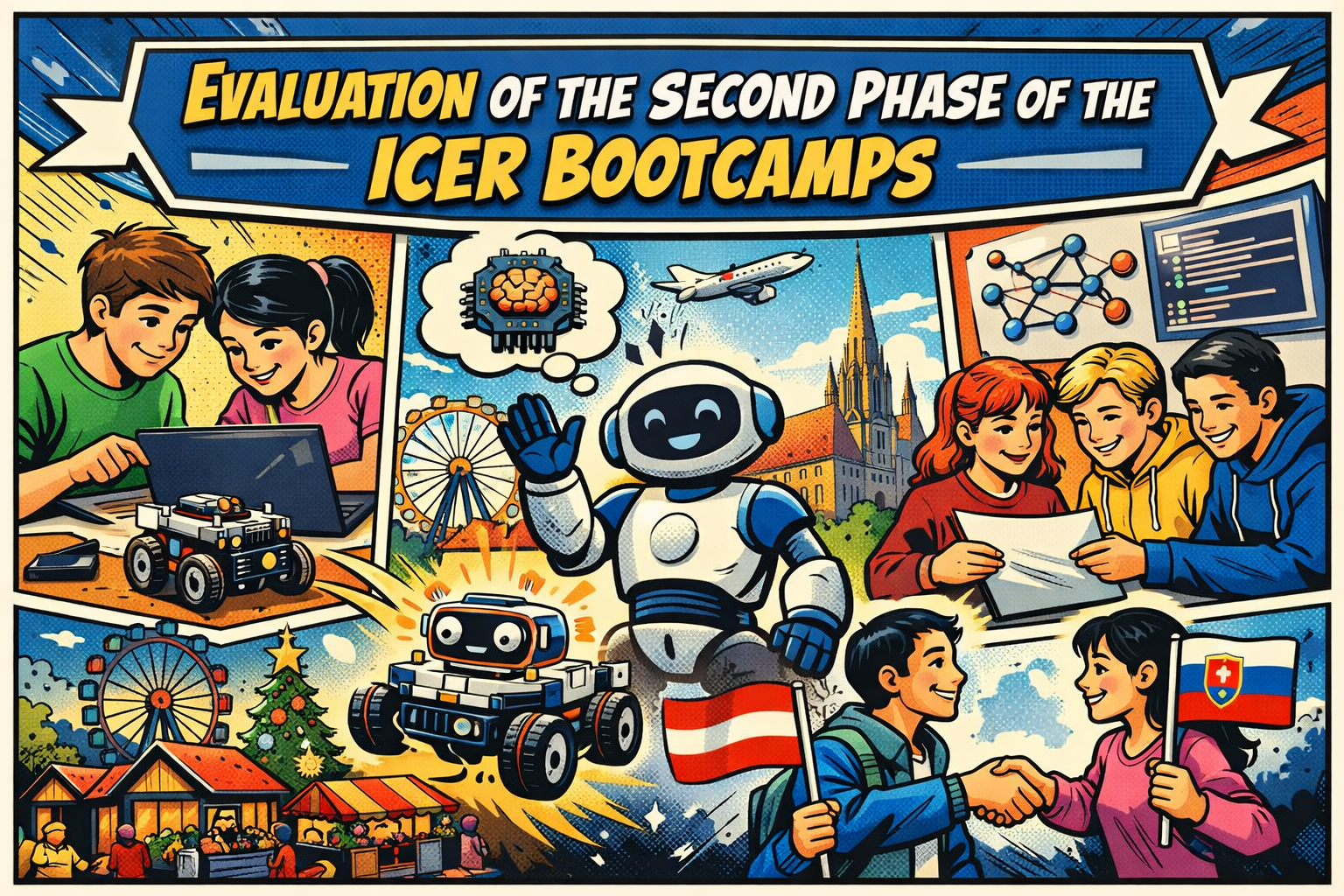
During the autumn months of 2025, the ICER project implemented the second phase of its international robotics bootcamps, bringing together students from Austria and Slovakia for intensive, hands-on learning experiences. Three bootcamps took place between November and December, involving students from GRG10 Laaerberg (Vienna), Spojená škola Mokrohájska, and SPŠE Hálova.
This article summarizes the key findings from participant feedback collected after each bootcamp and highlights recurring strengths, challenges, and lessons learned that will inform the final spring phase of the ICER bootcamps.
Overview of the Autumn Bootcamps
Across the three bootcamps:
- More than 50 students participated in total
- Programmes ran for three consecutive days
- Core activities focused on robotics (mBot), 3D modelling/printing, and AI fundamentals
- Each bootcamp combined technical workshops with cultural and social activities, such as city tours, visits to partner schools, and informal networking
Despite differences in student profiles and locations, the evaluation results reveal remarkably consistent patterns.
What Worked Well – Repeating Strengths Across All Bootcamps
1. Robotics as the strongest engagement driver
Across all three bootcamps, robotics achieved the highest learning and satisfaction scores. Students consistently reported strong confidence gains in programming and controlling robots, with average ratings around 4.0–4.4 on a 5-point scale.
One participant summarized this succinctly:
“Nothing to improve. The robotics part was very cool.”
Hands-on challenges, creative tasks (such as choreography or problem-solving scenarios), and teamwork proved to be the most motivating elements, regardless of prior experience.
2. High perceived learning impact in AI – with some caveats
AI-related activities were generally rated positively, especially in terms of basic understanding of AI concepts. Many students stated that the content was clear and accessible:
“Everything was clear to me.”
However, a recurring theme was that neural networks were perceived as the most difficult concept, even when overall satisfaction remained high:
“Still a little bit confused about the neural networks.”
This pattern appeared in all three bootcamps and points to AI as a valuable but cognitively demanding component.
3. Strong value of international and cultural experience
Cultural and social activities (city tours, visits to partner schools, Prater Technik, Christmas markets) consistently received very high ratings (often above 4.5/5).
Students appreciated learning in a different country and environment:
“The trip and the programme together made it special.”
These elements significantly enhanced motivation, group cohesion, and the overall memorability of the bootcamps, reinforcing the value of mobility-based STEM education.
4. Overall satisfaction despite diverse backgrounds
The bootcamps successfully accommodated:
- students with different prior levels of programming experience
- both general and technically oriented schools
- mixed national and linguistic backgrounds
Many participants explicitly stated that they would not change anything, which is a strong indicator of perceived quality:
“Nothing.”
“It was very cool.”
Recurring Challenges and Areas for Improvement
1. Catering and logistics can overshadow strong content
While learning outcomes were strong, logistical aspects—especially catering—had a disproportionate impact on overall satisfaction in at least one bootcamp. Where food quality or organization was rated poorly, it clearly affected the student experience, even when workshops were rated highly.
This highlights an important lesson: basic logistics must meet minimum quality standards, or they risk undermining educational impact.
2. Need for better pacing and modular design
Across all bootcamps, students expressed diverging preferences:
- some wanted longer sessions and more depth
- others requested shorter lectures and more breaks
As one student noted:
“Maybe shorter lectures, because I can’t pay attention for that long.”
This confirms the need for modular, flexible programme design, especially when working with heterogeneous groups.
3. Limited clarity about follow-up competitions
Interest in participating in a team robotics competition after the bootcamp was generally uncertain. The most common answer was “I don’t know”, suggesting that students lacked a clear understanding of:
- what the competition involves
- how demanding it is
- what they gain from participating
This trend appeared consistently across all three bootcamps.
Key Takeaways from the Second Phase
Summarizing the evaluation results, the following core features clearly define the ICER bootcamp model:
- Robotics is the central motivational anchor
- Hands-on, creative tasks outperform lecture-based formats
- AI is valuable but must remain practical and well-scaffolded
- International experience significantly amplifies impact
- Logistics matter as much as content
- Clear pathways after the bootcamp are still missing
Recommendations for the Final Spring Phase
Based on the autumn evaluation, the following recommendations are proposed for the final phase of ICER bootcamps in spring:
1. Strengthen robotics as the core, and integrate AI around it
- Keep robotics as the main storyline
- Embed AI concepts directly into robotics use cases
- Treat neural networks as an optional or advanced extension
2. Use a “core + extension” programme structure
- Define a clear minimum outcome for all participants
- Offer optional challenges for faster or more advanced teams
- Reduce long lecture blocks in favour of short inputs + practice
3. Improve communication about follow-up opportunities
- Present competitions as low-threshold, team-based showcases
- Introduce a small “mini-competition” during the bootcamp itself
- Clearly explain benefits: certificates, visibility, experience—not just winning
4. Secure logistics as a non-negotiable baseline
- Standardize catering and daily schedules
- Collect quick mid-bootcamp feedback to adjust in real time
Looking Ahead
The second phase of the ICER bootcamps confirms that the project is on the right strategic path. The model successfully combines robotics, digital skills, creativity, and international collaboration in a way that students value and enjoy.
The final spring phase offers an opportunity to fine-tune the format, strengthen continuity beyond the bootcamp itself, and maximize long-term impact—for students, teachers, and partner schools alike.