


A look back at the ICE Robotics Bootcamp series, 2025–2026
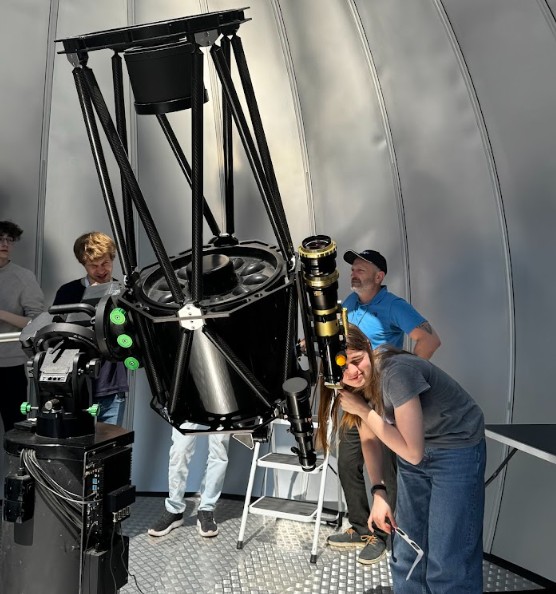
Over the past year, something quietly remarkable happened across eleven schools in Bratislava and Vienna. Two hundred students who had never touched a robot, written a line of Python, or opened a 3D-design program sat down together — Slovak and Austrian teenagers, side by side — and built things. Robots that danced. Masks that were designed, printed, and mounted onto working machines. Small AI models trained from scratch, live, in front of the people who trained them.
That’s the story of ICE Robotics: twelve international bootcamps, thirty teachers trained, ninety robotic kits and twenty laptops now sitting in school labs on both sides of the border, and a cross-border network that’s still growing.
Why we built this
Digital transformation isn’t a slogan for us — it’s a gap we could see clearly in the classroom. Across Europe, education systems are being asked to prepare students for a labour market that increasingly runs on robotics, AI, and digital fabrication, while traditional curricula often struggle to keep pace. Slovakia’s own national strategy for school digitalisation puts a fine point on it: too many students still finish school without hands-on experience of the technologies they’ll be expected to use at work.
ICE Robotics was our answer to that gap — not with another policy document, but with an actual robot on an actual desk, in front of an actual student, for three intensive days at a time.
What three days actually looked like
Each bootcamp followed the same “learning by doing” philosophy:
- 3D Modeling & Printing — students designed their own parts in Fusion 360, learning firsthand what “technical constraints” really means when your printed piece doesn’t fit.
- Robotics Programming — hands-on navigation and sensor work with mBot2 platforms, culminating for many groups in an mBot dance choreography competition (yes, robots that dance — it turns out that’s one of the best ways to make block-based logic feel like art).
- AI Fundamentals — a first, carefully paced encounter with machine learning and neural networks, introduced through simple classification games before anything more abstract.
Twelve of these sessions ran between March 2025 and June 2026, alternating between Bratislava and Vienna so that mobility — not just content — was part of the learning.
The numbers that made us proud
- 20% increase in technology-tool confidence at Gymnasium Schottenbastei (from 3.33 to 4.00)
- 3.1 → 4.6 jump in programming confidence at SPŠE Zochova
- 90 robotic kits and 20 laptops now permanently equipping partner schools
- Consistently the highest-rated activity across every cohort: “Building and programming the robots together.”
But the number that means the most to us isn’t in any spreadsheet. It’s a line from one student at SPŠE Zochova:
“I never thought I could do it, but it was so fun.”
That’s the gap we set out to close.
The hardest part — and how we handled it
We’ll be honest: AI was the topic students found hardest to wrap their heads around. So for future bootcamps, we’re formalising what worked — a three-step AI ladder: start with simple classification games, move to interactive “train a model” demonstrations, and save neural networks for an optional deep-dive for students who want to go further. Pair that with a “core + extension” model — a shared baseline for everyone, plus challenge cards for students ready to push harder — and every student leaves with real understanding, at their own pace.
(We also learned that logistics matter as much as pedagogy — a low catering score at one bootcamp taught us that standardised meals and clear dietary planning aren’t a nice-to-have, they’re foundational. Small lesson, but a real one.)
More than a workshop — a network
Beyond the robots and the code, ICE Robotics built something less visible but just as valuable: a genuine cross-border community. Teachers from Bratislava and Vienna now share methodology, swap lesson ideas, and know each other by name. Students got to experience the SmartLab STU environment in Bratislava, tour the Prater Technik exhibits in Vienna, and explore the city together on the Secret City Trail — activities that consistently scored above 4.5 out of 5 in participant feedback.
None of that shows up neatly in a KPI table, but it’s exactly the kind of durable institutional relationship that makes a project like this outlast its own funding period.
What’s next
Every methodology, tutorial, and lesson plan developed across the twelve bootcamps now lives on icerobotics.online, in three languages, freely available to any school that wants to build on what we’ve done. And for students who caught the robotics bug and want to keep going, the RoCoCo Robotic League offers an ongoing competitive pathway — because three days is a great start, but it shouldn’t have to be the end.
We’re proud of what these two hundred students, thirty teachers, and eleven schools built together. If this is what happens when you put a robot, a 3D printer, and a bit of Slovak-Austrian curiosity in the same room for three days — we can’t wait to see what the next cohort builds.
You can read the full report in the section Resources – Conference Papers and Recommendations.